Who can act next?
Enterprise Intelligence connects source records to ownership, dependencies, and the decision behind a number.
Explore Enterprise IntelligenceI build API-connected dashboards and AI-assisted evidence workflows. When information is scattered and ownership is unclear, I make the next responsible action visible.
Greg Erickson · Systems architecture, applied AI, and assurance.
Curious about how things work—and the people who keep them working.
30 years in technology. 18 years in fintech.
Coordinated security and compliance reviews (PCI/SOC) across 13 business units.
Review my résumé

Choose a connection, or use the direct links above.
How I collaborate across owners, teams, and responsibilities.
Connected records, ownership, and the next responsible action.
The tools and platforms behind my integration and AI work.
Connect what a control means to behavior and evidence.
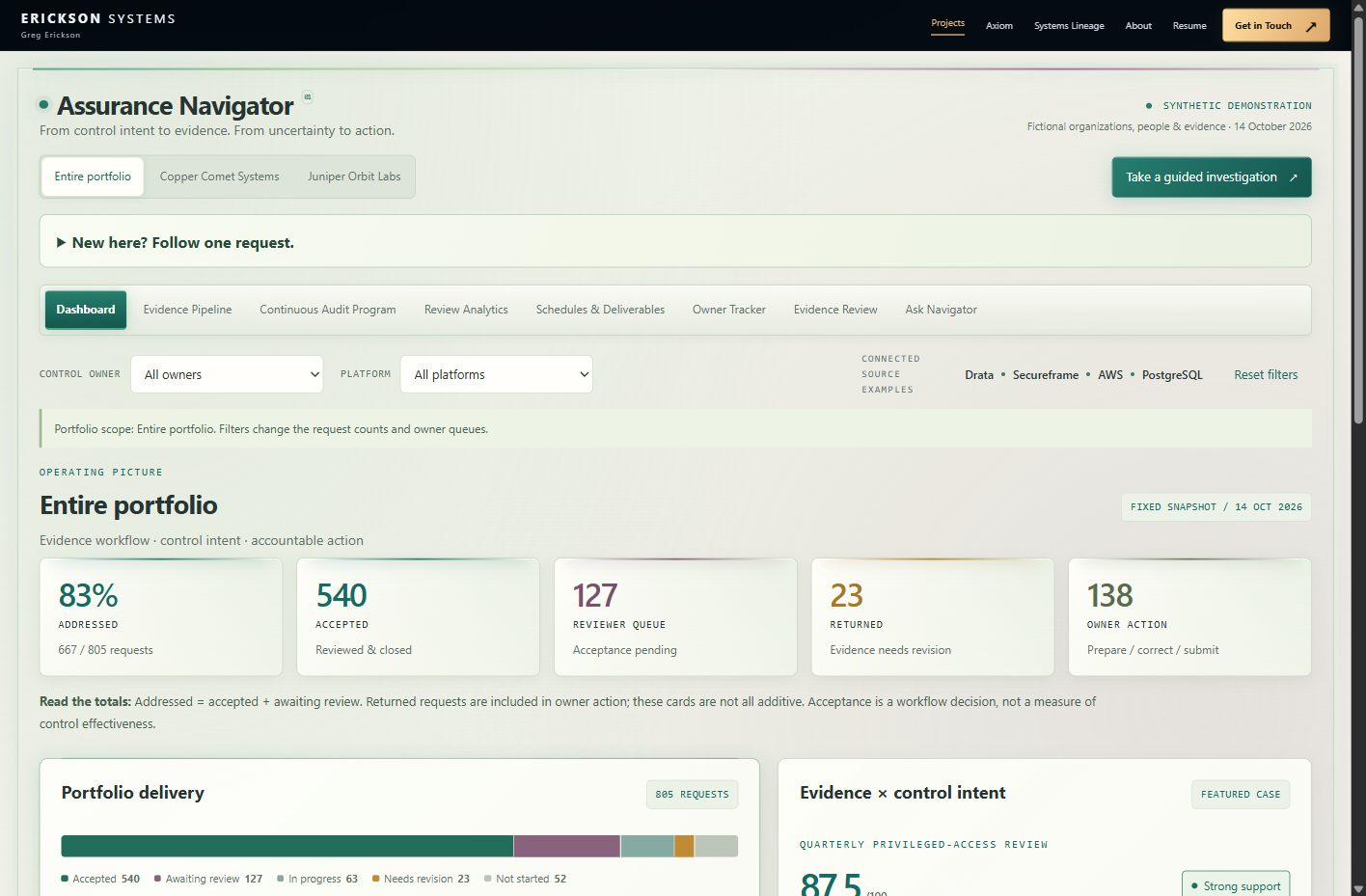
Inspect Assurance Navigator using clearly labeled synthetic data.
I connected compliance platforms and built shared views of evidence, owners, review queues, and deadlines. The public example lets you follow the work behind a total.
Synthetic public demonstration
805 fictional requests across connected dashboards and investigation screens. No external business systems are connected. Optional live AI availability is shown in Ask Navigator.
An open request might need an owner to prepare evidence, or it might be waiting for a reviewer. Those are different next steps.
I built API integrations and a shared operating model that retains source status, ownership, and the path back to a request.
Keep those states separate so the view explains who can act. Workflow progress alone does not establish control effectiveness.
I built an AI workbench using AWS Bedrock and Claude, semantic retrieval, and persistent context. It brings requirements and source evidence into the same review.
The purpose is a useful lead for investigation, with enough context for a person to check the interpretation.
Explore the workbench approachThese figures describe a separate comparison against PCI DSS 4.0.1. Flags are review leads, not confirmed control failures or a model-accuracy measure.
The source evidence for this review is private. Assurance Navigator is a separate synthetic demonstration.
Enterprise Intelligence connects source records to ownership, dependencies, and the decision behind a number.
Explore Enterprise IntelligenceI built Axiom to retain memory outside one AI connection, completed a migration, and tested continuity with a fresh Claude instance. Explore memory, weighting and team handoffs.
Explore AxiomFollow the connection between an intended outcome, operating behavior, and what the evidence establishes.
Explore Control IntentAn odd sound in a mechanical system, an aging request in an enterprise process, and a stale conclusion in an AI system are different signals. The reasoning behind them shares a structure.
First establish what changed. Then examine what depends on it, which assumptions are being trusted, and which correction will actually hold.
This small interactive model illustrates that approach. It is a thinking tool, not a simulation or a record of a specific employer system.
A ventilation motor changes pitch before stopping.
Compare to its normal sound. A bearing or load may be changing.
Air exchange, temperature, animal health and backup power share the risk.
Inspect the motor, verify airflow and prepare the contingency path.
Illustrations demonstrate a method of inquiry, not measured results or completed deployments.
On the farm, a change in a ventilation motor's pitch could tell you something was wrong before it stopped. Power, air, animals, and people depended on the same system.
That habit of following a signal became computing, networks, payments technology, assurance, and AI.
Read the systems lineageBring the messy version: the integration that won’t cooperate, the workflow nobody can see end to end, or the question you’re still working out. We can find a place to start.